
Vulnerability Prioritization: CVSS vs CISA

For years, corporate vulnerability management followed an almost mathematical rule: if a flaw received a high score on the CVSS (Common Vulnerability Scoring System), it was prioritized immediately. On the other hand, if the score was low, it was pushed to the back of the queue. Every flaw received its official identifier through a CVE (Common Vulnerabilities and Exposures) code, basing its criticality on fixed theoretical parameters that analysts input into tools like the NIST CVSS Score Calculator. Security teams blindly assumed that the mathematical severity of the metric matched the actual risk to their infrastructure.
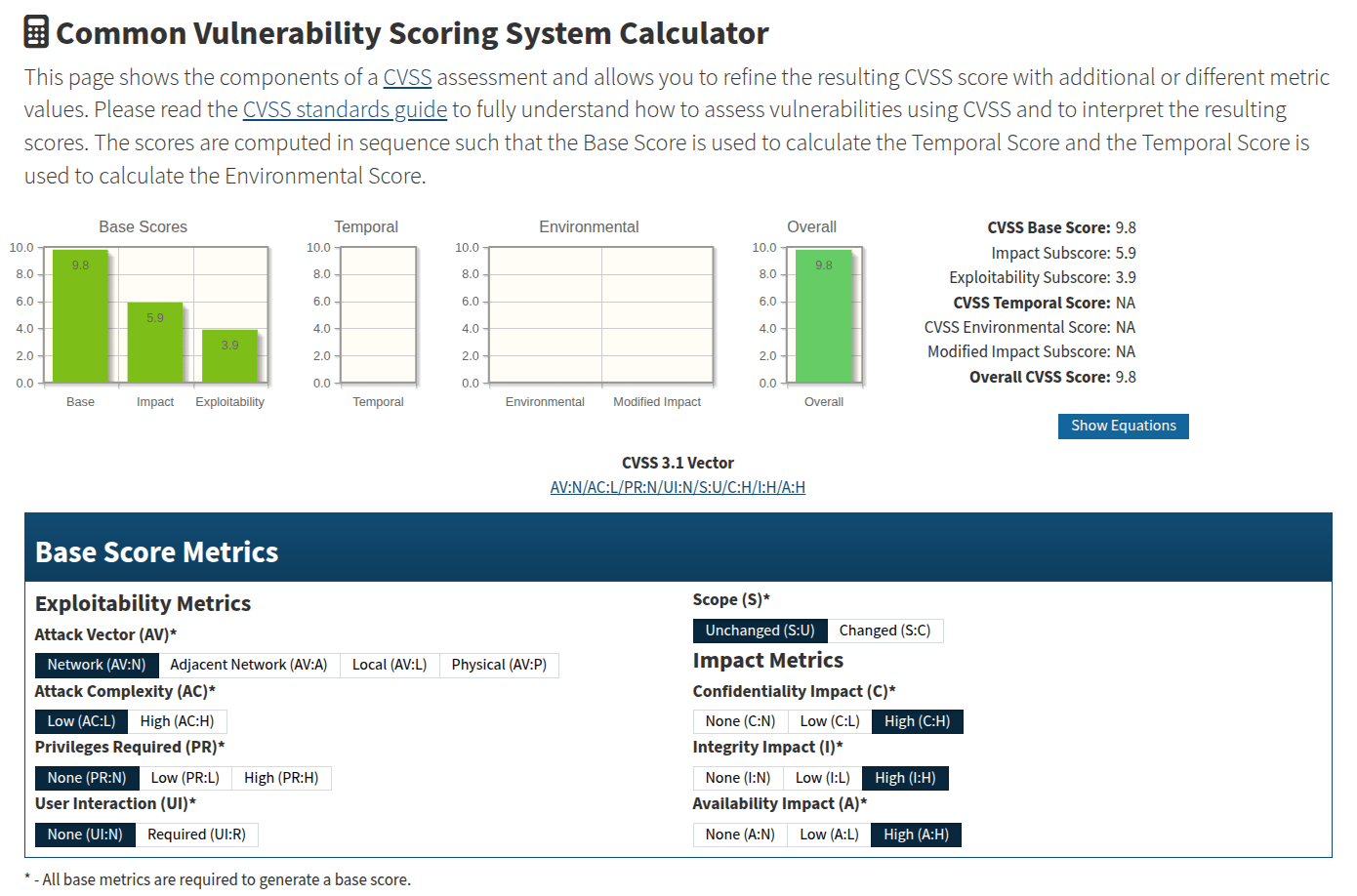
Theoretical scoring example (CVSS 9.8): The traditional NIST model measures a CVE's potential severity in isolation, without factoring in whether it is actually being exploited in the real world.
However, in today's threat landscape, this static model poses significant operational challenges due to the massive and constant release of vulnerabilities with critically high CVSS scores. This saturation of maximum-severity alerts dilutes the response capacity of defense teams, sparking a fundamental debate for security leaders: how to accurately determine which flaws must be resolved first based on real risk criteria.
The answer does not lie in the theoretical severity of the code, but in the actual exploitation context. This paradigm shift has recently been consolidated by international organizations like CISA through new risk response guidelines, paving the way for how Cyber Threat Intelligence (CTI) should guide decision-making.
The New Roadmap: Understanding Risk-Based Remediation Timelines
To overcome the limitations of the traditional model, CISA's Binding Operational Directive (BOD) has established a completely different prioritization logic. It is no longer just about the CVSS score, the operational context of the flaw is what determines urgency.
As seen in CISA's remediation decision-making workflow, the key questions change radically:
- Publicly Exposed: Is the asset directly visible on the internet?
- Presence in the KEV Catalog: Is there evidence that attackers are already actively exploiting this CVE in the real world?
- Automation Capacity: Can a malicious actor develop a script to attack this flaw massively and automatically?
- Technical Impact: Is the compromise total or partial?
Based on these variables, fixing timelines become dynamic and are divided into four clear risk levels: 3 days (which also requires an urgent forensic triage) for the most critical and exposed cases, 14 days for severe but non-automated threats, 60 days for flaws with lower network exposure, and finally, addressing the issue in the next system upgrade when the impact is minimal or there is no real danger of an attack.
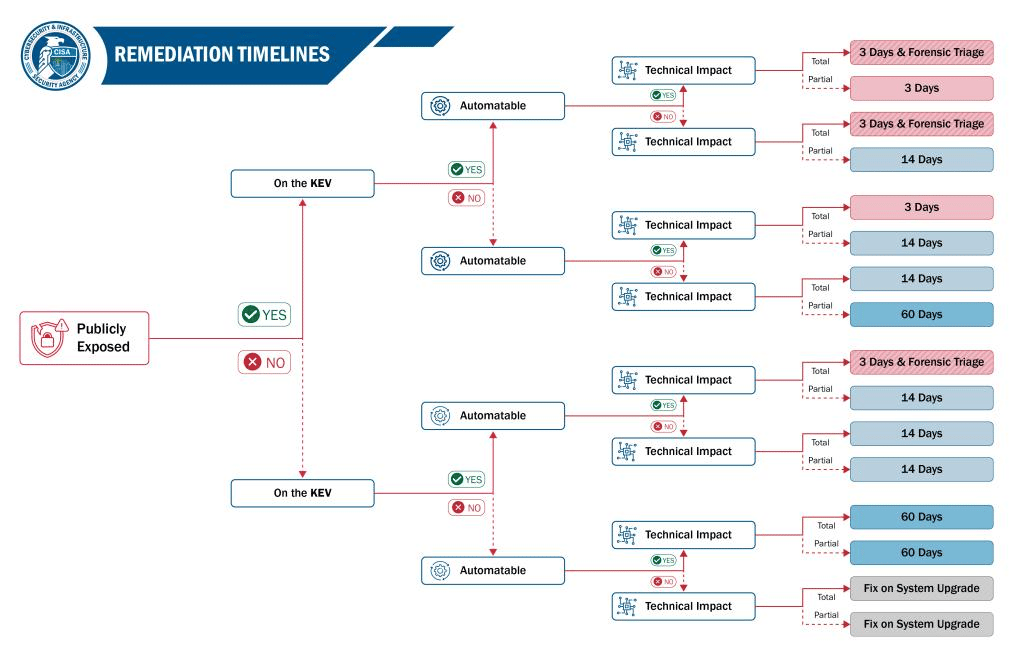
Remediation Timeline tree from CISA BOD 26-04
The Strategic Value of CTI: Turning Data into Decisions with Vysion
To bridge the gap between the theoretical severity of a CVE and the real-world danger, the SOC cannot rely solely on official advisories; it needs a bridge connecting its defenses with the attacker's ecosystem. This is where integrating a Cyber Threat Intelligence platform at the core of the strategy mitigates alert saturation, allowing teams to enrich each vulnerability with real-time contextual information and redefine its true criticality under three operational pillars:
- Validation of Real Exploitation: It confirms whether threat actors are sharing functional Proof of Concepts (PoCs), developing automated attack scripts, or selling initial access based on a specific flaw.
- Measuring Popularity and Adoption: A CVE with a moderate CVSS score may require immediate attention if it sees a spike in mentions and demand within the Darknet, while a critical flaw (CVSS 9.8) with no activity in underground environments can be safely deprioritized.
- Optimizing Patching Efforts: By cross-referencing internal telemetry with criminal ecosystem intelligence, security teams stop patching blindly based on abstract numbers, focusing their resources exclusively on the gaps that attackers are actively trying to exploit.
As a technological response to this challenge, at Byron Labs we developed Vysion, a cyber intelligence platform designed to plug directly into this decision-making workflow. When analysts identify a CVE code within the organization, Vysion allows them to audit its live status by continuously indexing Dark Web forums, ransomware leak repositories, and encrypted messaging channels.
To understand how this visibility comes to life in an analyst's daily workflow, the platform provides direct access to the raw sources where threats are developed:
-png-1.png&w=1920&q=75)
Dark Web forum threat view inside Vysion: Indexing and previewing a technical thread within a closed forum, where a malicious actor shares an exploit script for a CVE (a WordPress SQL injection) before the threat spreads across public networks.
-png-1.png&w=1920&q=75) Encrypted messaging intelligence view inside Vysion: The platform monitors chat environments (in this case, the JokersDarkNET criminal group on Telegram) where threat actors directly distribute active exploit lists and Proof of Concepts (PoCs) for specific CVEs.
Encrypted messaging intelligence view inside Vysion: The platform monitors chat environments (in this case, the JokersDarkNET criminal group on Telegram) where threat actors directly distribute active exploit lists and Proof of Concepts (PoCs) for specific CVEs.
By processing millions of records daily using Machine Learning models trained in the language of cybercrime, the platform filters out generic noise and provides the traceability needed for the SOC to validate the origin of a threat. In this way, Vysion demonstrates how specialized CTI transforms massive alert volumes into a visual, auditable mitigation strategy driven by real evidence from the criminal market.